For laboratory research use only — not for human or veterinary use. Not evaluated by the U.S. FDA.
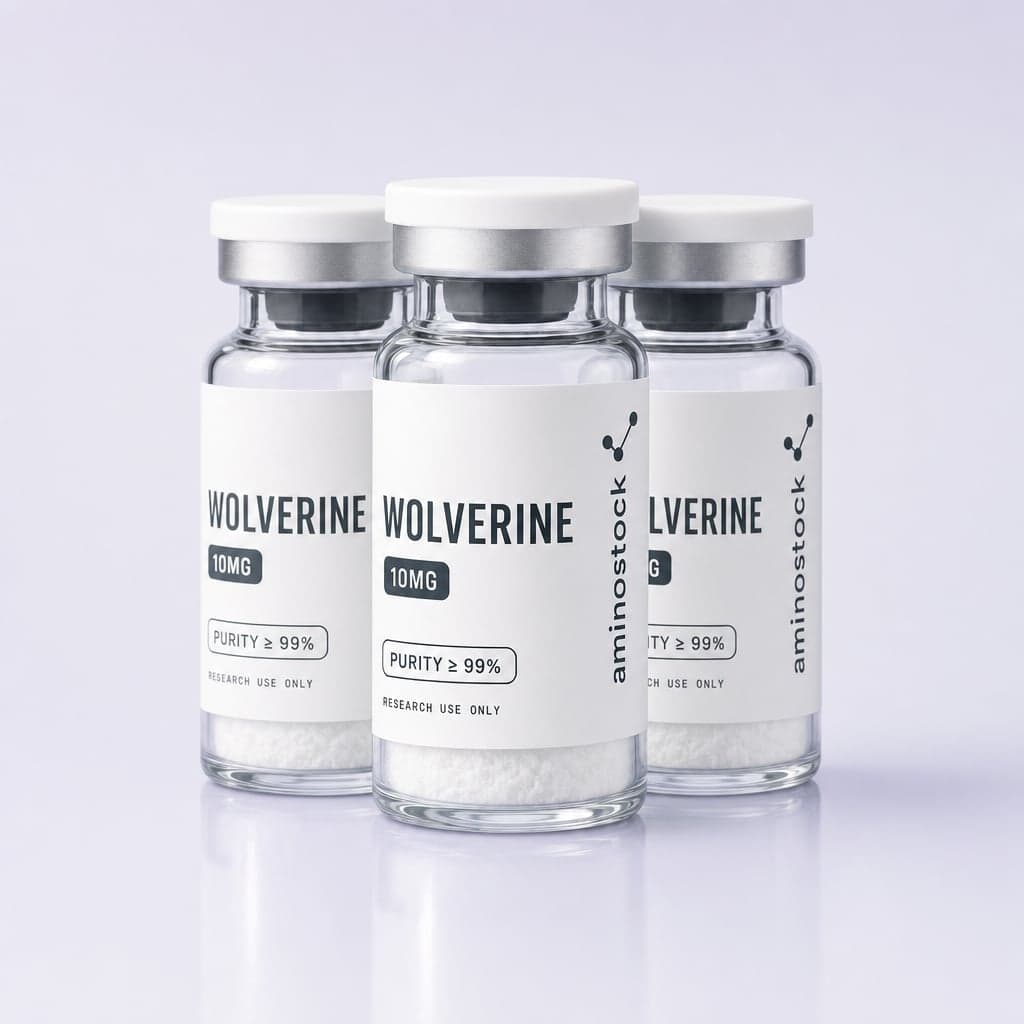
Cellular Peptide Blend
BPC-157/TB-500 (Wolverine)
A two-peptide research blend of BPC-157 and TB-500 combined to study complementary tissue-repair and regenerative pathways in animal models.
Size
Quantity
$79.99
Bundle & save
Order by 3:00 PM ET for same-day dispatch
Cutoff 3:00 PM ET · same-day dispatch
Estimated arrival in 2 business days
Overnight shipping available
Free shipment protection included
BPC-157/TB-500 (Wolverine)
1 × 10mg · $79.99
99% purity, QC passed
HPLC + mass-spec verified
Shipment protection
Free on every order
Free shipping over $150
Same-day dispatch before 3PM ET
About BPC-157/TB-500 (Wolverine)
Structure and research context
This research blend contains two separately characterized peptides. BPC-157 is a synthetic linear pentadecapeptide (GEPPPGKPADDAGLV, about 1,419.5 g/mol) corresponding to a partial sequence of a protein fraction isolated from gastric juice. TB-500 corresponds to thymosin beta-4, a 43-residue polypeptide of about 5 kDa and the most abundant member of the beta-thymosin family in mammalian tissue, where it acts as the main G-actin sequestering peptide. The two components are structurally unrelated: one is a short proline-rich peptide without disulfide bridges, the other a larger actin-binding polypeptide.
BPC-157/TB-500 (Wolverine) in the research literature
Most published studies examine each component on its own. BPC-157 has been examined in rat tendon fibroblast explant and culture systems, where it increased outgrowth, migration and spreading together with FAK and paxillin phosphorylation, and in isolated rat aorta and endothelial cells, where it was linked to nitric oxide generation through Src, caveolin-1 and eNOS. Thymosin beta-4 has been examined in endothelial migration and aortic-ring sprouting assays, in which a seven-residue actin-binding motif reproduced the activity of the full peptide.
A 2026 exploratory study in a rat Achilles tendon transection model included BPC-157, TB-500 and dual-peptide groups; the authors reported no additional histologic or biomechanical effect in the dual-peptide group relative to either peptide alone.
Summarized from peer-reviewed literature for research context only; not a product claim. PubMed: 21030672 · 33051481 · 14500546 · 42542926
BPC-157/TB-500 (Wolverine) Certificate of Analysis
Third-party tested · Independent analytical lab
10mg
| Tested | Measured |
|---|---|
| Jul 2026 | BPC-157 10.90mg · TB-500 12.54mg |
| Jul 2026 | BPC-157 15.27mg · TB-500 14.33mg |
| Jun 2026 | BPC-157 12.42mg · TB-500 12.74mg |
| Jun 2026 | BPC-157 12.33mg · TB-500 12.46mg |
| May 2026 | BPC-157 12.83mg · TB-500 12.05mg |
| May 2026 | BPC-157 12.83mg · TB-500 12.06mg |
| Apr 2026 | BPC-157 12.60mg · TB-500 11.90mg |
| Apr 2026 | BPC-157 12.16mg · TB-500 11.55mg |
| Apr 2026 | BPC-157 11.38mg · TB-500 11.45mg |
| Feb 2026 | BPC-157 11.93mg · TB-500 11.79mg |
Frequently researched together
Commonly studied alongside BPC-157/TB-500 (Wolverine).
Compound information
Technical specifications
Molecular profile
| Type | Synthetic pentadecapeptide |
| CAS number | 137525-51-0 |
| Molecular weight | 1,419.5 g/mol |
| Amino acids | 15 |
| Sequence | GEPPPGKPADDAGLV |
Storage & stability
- ❄️
Lyophilized (powder)
-20°C · stable 2+ years
- ❄️
Reconstituted
2–8°C · use within 30 days
BPC-157/TB-500 (Wolverine) sources & references
Peer-reviewed literature, for research context
- GlobalRPH Clinical Review
BPC-157 and TB-500: Background, Indications, Efficacy, and Safety
2025McAuley D
View source - HSS Journal (NIH/PubMed Central)
Emerging Use of BPC-157 in Orthopaedic Sports Medicine: A Systematic Review
2025·DOI: 10.1177/15563316251355551·PMID: 40756949Vasireddi N, Hahamyan H, Salata MJ, Karns M, Calcei JG, Voos JE, Apostolakos JM
View source - Expert Opinion on Biological Therapy
Thymosin β4: a multi-functional regenerative peptide. Basic properties and clinical applications
2012·DOI: 10.1517/14712598.2012.634793·PMID: 22074294Goldstein AL, Hannappel E, Sosne G, Kleinman HK
View source - Annals of the New York Academy of Sciences
A randomized, placebo-controlled, single and multiple dose study of intravenous thymosin beta4 in healthy volunteers
2010·DOI: 10.1111/j.1749-6632.2010.05474.x·PMID: 20536472Ruff D, Crockford D, Girardi G, Zhang Y
View source - Journal of Investigative Dermatology
Thymosin beta4 accelerates wound healing
1999·DOI: 10.1046/j.1523-1747.1999.00708.x·PMID: 10469335Malinda KM, Sidhu GS, Mani H, Banaudha K, Maheshwari RK, Goldstein AL, Kleinman HK
View source - Journal of Applied Physiology
The promoting effect of pentadecapeptide BPC 157 on tendon healing involves tendon outgrowth, cell survival, and cell migration
2011·DOI: 10.1152/japplphysiol.00945.2010·PMID: 21030672Chang CH, Tsai WC, Lin MS, Hsu YH, Pang JH
View source - Scientific Reports (Nature)
Modulatory effects of BPC 157 on vasomotor tone and the activation of Src-Caveolin-1-endothelial nitric oxide synthase pathway
2020·DOI: 10.1038/s41598-020-74022-y·PMID: 33051481Hsieh MJ, Lee CH, Chueh HY, et al.
View source - Regulatory Toxicology and Pharmacology
Preclinical safety evaluation of body protective compound-157, a potential drug for treating various wounds
2020·DOI: 10.1016/j.yrtph.2020.104665·PMID: 32334036Xu C, Sun L, Ren F, et al.
View source
More in Tissue Repair
Every Tissue Repair research compound in the catalog.
Important research notice
Not for human consumption. This product is sold exclusively for laboratory and in vitro research. It is not intended to diagnose, treat, cure, or prevent any disease.
Any research findings referenced on this page are drawn from published, peer-reviewed literature and are provided for educational context only. They are not product claims and should not be read as medical advice.
By purchasing, you confirm you are a qualified researcher and will handle this material in accordance with all applicable laws and institutional guidelines.