For laboratory research use only — not for human or veterinary use. Not evaluated by the U.S. FDA.
Dermal Peptide
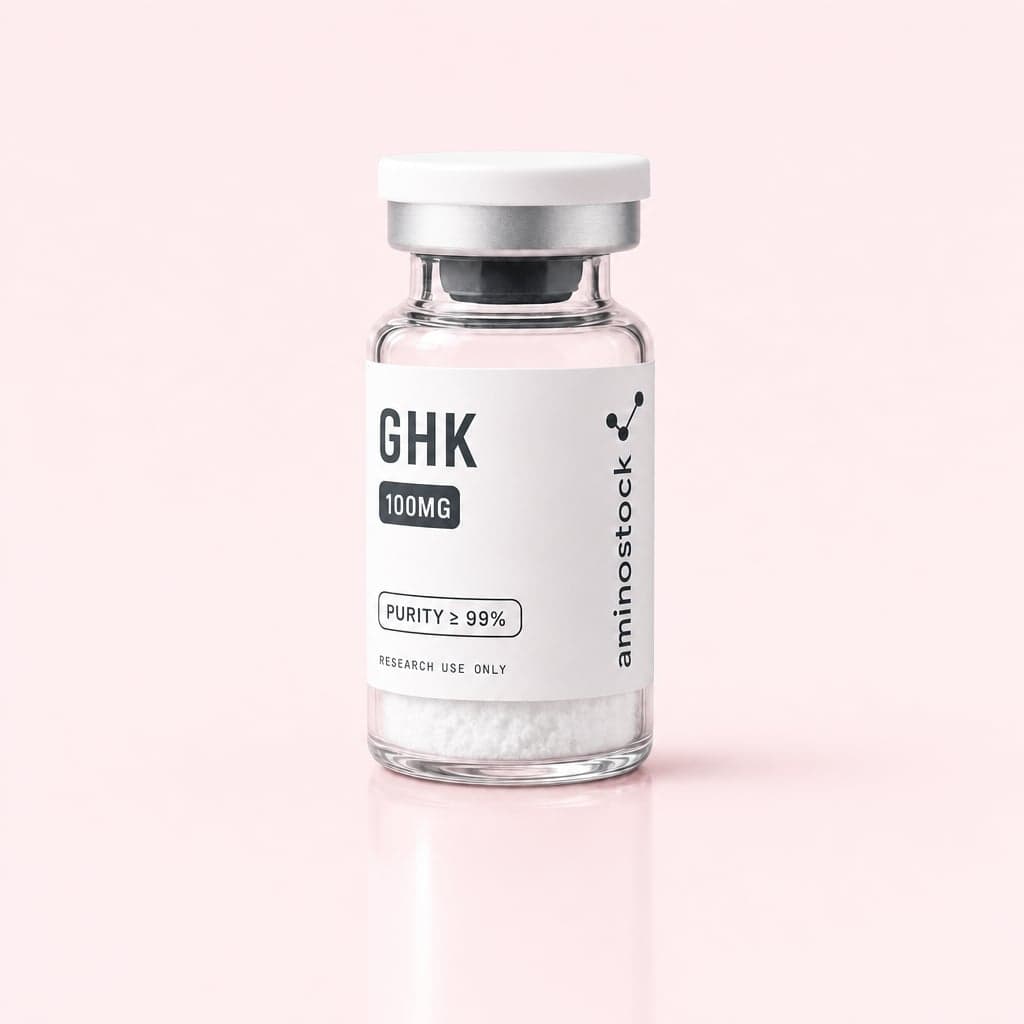
GHK (Basic)
The copper-free form of the glycyl-histidyl-lysine tripeptide, studied in dermal research models for matrix-remodeling signaling without the bound copper ion of GHK-Cu.
Quantity
$78.99
Bundle & save
Order by 3:00 PM ET for same-day dispatch
Cutoff 3:00 PM ET · same-day dispatch
Estimated arrival in 2 business days
Overnight shipping available
Free shipment protection included
GHK (Basic)
1 × 100mg · $78.99
99% purity, QC passed
HPLC + mass-spec verified
Shipment protection
Free on every order
Free shipping over $150
Same-day dispatch before 3PM ET
About GHK (Basic)
Structure and research context
GHK (glycyl-L-histidyl-L-lysine; Gly-His-Lys, C14H24N6O4, about 340.38 g/mol) is the free tripeptide without a bound metal ion. It was first isolated as a plasma growth-modulating factor that co-purified with approximately equimolar copper, and its histidyl-lysyl linkage resembles the copper-transport sites of albumin. The free peptide is a naturally occurring high-affinity Cu(II) chelator; when copper is present it binds the metal through its N-terminal amine, a backbone amide nitrogen and the histidine imidazole. In solution the uncomplexed peptide adopts a quasi-folded conformation stabilized by four intramolecular hydrogen bonds.
GHK (Basic) in the research literature
Research on the copper-free peptide has focused on its chemistry as a metal-binding and aldehyde-scavenging molecule. Mass spectrometry, 1H NMR and computational studies showed that GHK forms adducts with the lipid-peroxidation aldehyde 4-hydroxy-2-nonenal at pH 7.4, although it reacted less readily than carnosine. In cell-culture work, GHK bound copper and reduced its redox activity, attenuated copper- and zinc-induced death of central nervous system cells in vitro, and reduced and partially reversed metal-induced aggregation of bovine serum albumin.
The distinction from the copper complex matters in some assays: in dermal fibroblast cultures, the increase in MMP-2 observed with GHK-Cu was reproduced by copper ions but not by GHK alone.
Summarized from peer-reviewed literature for research context only; not a product claim. PubMed: 7453802 · 21780203 · 17672515 · 38599632 · 11045606
Frequently researched together
Commonly studied alongside GHK (Basic).
Compound information
Technical specifications
Molecular profile
| Type | Copper-free tripeptide |
| CAS number | 1227510-36-2 |
| Molecular weight | 340.38 g/mol |
| Amino acids | 3 |
| Sequence | Gly-His-Lys |
| Formula | C14H24N6O4 |
Storage & stability
- ❄️
Lyophilized (powder)
-20°C · stable 2+ years
- ❄️
Reconstituted
2–8°C · use within 30 days
GHK (Basic) sources & references
Peer-reviewed literature, for research context
- Chemical research in toxicology
Glycyl-histidyl-lysine (GHK) is a quencher of alpha,beta-4-hydroxy-trans-2-nonenal: a comparison with carnosine. insights into the mechanism of reaction by electrospray ionization mass spectrometry, 1H NMR, and computational techniques
2007·DOI: 10.1021/tx700185s·PMID: 17672515Beretta G, Artali R, Regazzoni L, Panigati M, Facino RM
View source - Metallomics : integrated biometal science
Glycyl-l-histidyl-l-lysine prevents copper- and zinc-induced protein aggregation and central nervous system cell death in vitro
2024·DOI: 10.1093/mtomcs/mfae019·PMID: 38599632Min JH, Sarlus H, Harris RA
View source - Life sciences
The tripeptide-copper complex glycyl-L-histidyl-L-lysine-Cu2+ stimulates matrix metalloproteinase-2 expression by fibroblast cultures
2000·DOI: 10.1016/s0024-3205(00)00803-1·PMID: 11045606Siméon A, Emonard H, Hornebeck W, Maquart FX
View source - Redox biology
The glycyl-l-histidyl-l-lysine-Cu(2+) tripeptide complex attenuates lung inflammation and fibrosis in silicosis by targeting peroxiredoxin 6
2024·DOI: 10.1016/j.redox.2024.103237·PMID: 38879894Bian Y, Deng M, Liu J, Li J, Zhang Q, Wang Z
View source
More in Dermal
Every Dermal research compound in the catalog.
Important research notice
Not for human consumption. This product is sold exclusively for laboratory and in vitro research. It is not intended to diagnose, treat, cure, or prevent any disease.
Any research findings referenced on this page are drawn from published, peer-reviewed literature and are provided for educational context only. They are not product claims and should not be read as medical advice.
By purchasing, you confirm you are a qualified researcher and will handle this material in accordance with all applicable laws and institutional guidelines.