For laboratory research use only — not for human or veterinary use. Not evaluated by the U.S. FDA.
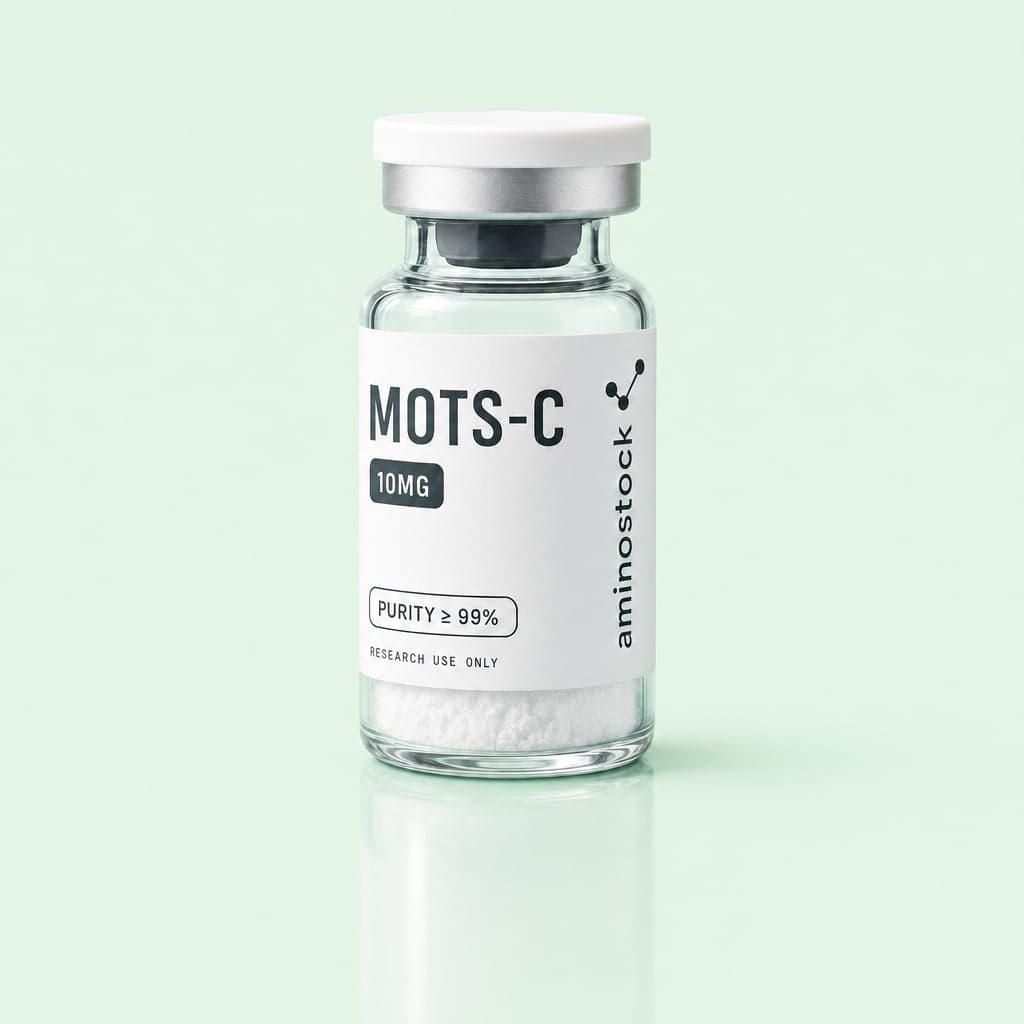
Metabolic Peptide
MOTS-C
A mitochondrial-derived peptide of 16 residues studied in rodent models for its influence on AMPK signaling and exercise-related metabolism.
Size
Quantity
$39.99
Bundle & save
Order by 3:00 PM ET for same-day dispatch
Cutoff 3:00 PM ET · same-day dispatch
Estimated arrival in 2 business days
Overnight shipping available
Free shipment protection included
MOTS-C
1 × 10mg · $39.99
99% purity, QC passed
HPLC + mass-spec verified
Shipment protection
Free on every order
Free shipping over $150
Same-day dispatch before 3PM ET
About MOTS-C
Structure and research context
MOTS-c (mitochondrial open reading frame of the 12S rRNA type-c) is a 16-residue peptide, MRWQEMGYIFYPRKLR, encoded by a short open reading frame within the mitochondrial 12S rRNA gene. It belongs to the family of mitochondrial-derived peptides that also includes humanin, and its identification supported the view that the mitochondrial genome encodes signaling peptides in addition to its classical protein-coding genes. The synthetic peptide has the formula C101H152N28O22S2 and a molar mass of about 2,174.6 g/mol.
MOTS-C in the research literature
In the founding cell and mouse studies, MOTS-c was reported to act primarily on skeletal muscle, where it inhibited folate one-carbon metabolism and the tethered de novo purine biosynthesis pathway, leading to AMPK activation. Later cell work showed that under metabolic stress, such as glucose restriction, the peptide translocates to the nucleus in an AMPK-dependent manner, regulates a broad set of genes including those carrying antioxidant response elements, and interacts with the stress-responsive transcription factor NRF2.
In mouse models, MOTS-c has been studied for its effects on skeletal-muscle metabolic adaptation in young, middle-aged and old animals, on nuclear genes related to metabolism and proteostasis, and on myoblast adaptation to metabolic stress. An unbiased plasma metabolomics study in diet-induced mouse models reported changes in sphingolipid, monoacylglycerol and dicarboxylate metabolism pathways.
Summarized from peer-reviewed literature for research context only; not a product claim. PubMed: 25738459 · 29983246 · 33473109 · 31293078
MOTS-C Certificate of Analysis
Third-party tested · Independent analytical lab
10mg
98.68%latest
| Tested | Measured | Purity |
|---|---|---|
| Jul 2026 | 11.20mg | 98.68% |
| Jun 2026 | 11.22mg | 98.97% |
| Jun 2026 | 11.32mg | 99.01% |
| Jun 2026 | 11.29mg | 99.58% |
| May 2026 | 11.79mg | 98.73% |
| May 2026 | 11.51mg | 99.00% |
| Apr 2026 | 11.82mg | 99.03% |
| Mar 2026 | 11.40mg | 99.00% |
| Mar 2026 | 11.89mg | 99.44% |
| Feb 2026 | 12.41mg | 99.66% |
20mg
99.14%latest
| Tested | Measured | Purity |
|---|---|---|
| Jul 2026 | 23.37mg | 99.14% |
| Jun 2026 | 23.38mg | 99.20% |
| Jun 2026 | 23.03mg | 98.82% |
| May 2026 | 23.09mg | 99.22% |
| May 2026 | 23.40mg | 99.05% |
| Apr 2026 | 23.65mg | 99.37% |
| Jan 2026 | 23.12mg | 99.36% |
| Jan 2026 | 22.46mg | 99.52% |
| Jan 2026 | 23.07mg | 99.47% |
| Dec 2025 | 24.37mg | 99.51% |
40mg
99.22%latest
| Tested | Measured | Purity |
|---|---|---|
| Jul 2026 | 48.71mg | 99.22% |
| Jul 2026 | 47.53mg | 99.04% |
| Jun 2026 | 48.14mg | 98.91% |
| May 2026 | 47.49mg | 99.38% |
| May 2026 | 48.07mg | 99.06% |
| May 2026 | 47.37mg | 99.02% |
| Apr 2026 | 47.65mg | 99.29% |
| Mar 2026 | 48.34mg | 99.04% |
| Jan 2026 | 49.55mg | 99.42% |
| Jan 2026 | 46.60mg | 99.39% |
Frequently researched together
Commonly studied alongside MOTS-C.
Compound information
Technical specifications
Molecular profile
| Type | Mitochondrial-derived peptide |
| CAS number | 1627580-64-6 |
| Molecular weight | 2,174.6 g/mol |
| Amino acids | 16 |
| Sequence | MRWQEMGYIFYPRKLR |
| Formula | C101H152N28O22S2 |
Storage & stability
- ❄️
Lyophilized (powder)
-20°C · stable 2+ years
- ❄️
Reconstituted
2–8°C · use within 30 days
MOTS-C sources & references
Peer-reviewed literature, for research context
- Cell Metabolism
The Mitochondrial-Derived Peptide MOTS-c Promotes Metabolic Homeostasis and Reduces Obesity and Insulin Resistance
2015·DOI: 10.1016/j.cmet.2015.02.009·PMID: 25738459Lee C, Zeng J, Drew BG et al.
View source - Nature Communications
MOTS-c is an exercise-induced mitochondrial-encoded regulator of age-dependent physical decline and muscle homeostasis
2021·DOI: 10.1038/s41467-020-20790-0Reynolds JC, Lai RW, Woodhead JST et al.
View source - Alzheimer's Drug Discovery Foundation
MOTS-c Cognitive Vitality Report
2021ADDF Aging and Alzheimer's Prevention Program
View source - Aging Cell
The mitochondrial-derived peptide MOTS-c: a player in exceptional longevity?
2015·DOI: 10.1111/acel.12389·PMID: 26289118Fuku N, Pareja-Galeano H, Zempo H et al.
View source - Physiol Rep
The mitochondrial-derived peptide MOTS-c is a regulator of plasma metabolites and enhances insulin sensitivity
2019·PMID: 31293078Kim S-J, Miller B, Mehta HH et al.
View source - Biochemical and Biophysical Research Communications
Mitochondria related peptide MOTS-c suppresses ovariectomy-induced bone loss via AMPK activation
2016Ming W, Lu G, Xin S et al.
View source - Pediatric Diabetes
Circulating MOTS-c levels are decreased in obese male children and adolescents and associated with insulin resistance
2018Du C, Zhang C, Wu W et al.
View source - ClinicalTrials.gov
Study of CB4211 in Patients With Nonalcoholic Fatty Liver Disease (NAFLD) and Obesity
2019CohBar, Inc.
View source
More in Metabolic
Every Metabolic research compound in the catalog.
Important research notice
Not for human consumption. This product is sold exclusively for laboratory and in vitro research. It is not intended to diagnose, treat, cure, or prevent any disease.
Any research findings referenced on this page are drawn from published, peer-reviewed literature and are provided for educational context only. They are not product claims and should not be read as medical advice.
By purchasing, you confirm you are a qualified researcher and will handle this material in accordance with all applicable laws and institutional guidelines.