For laboratory research use only — not for human or veterinary use. Not evaluated by the U.S. FDA.
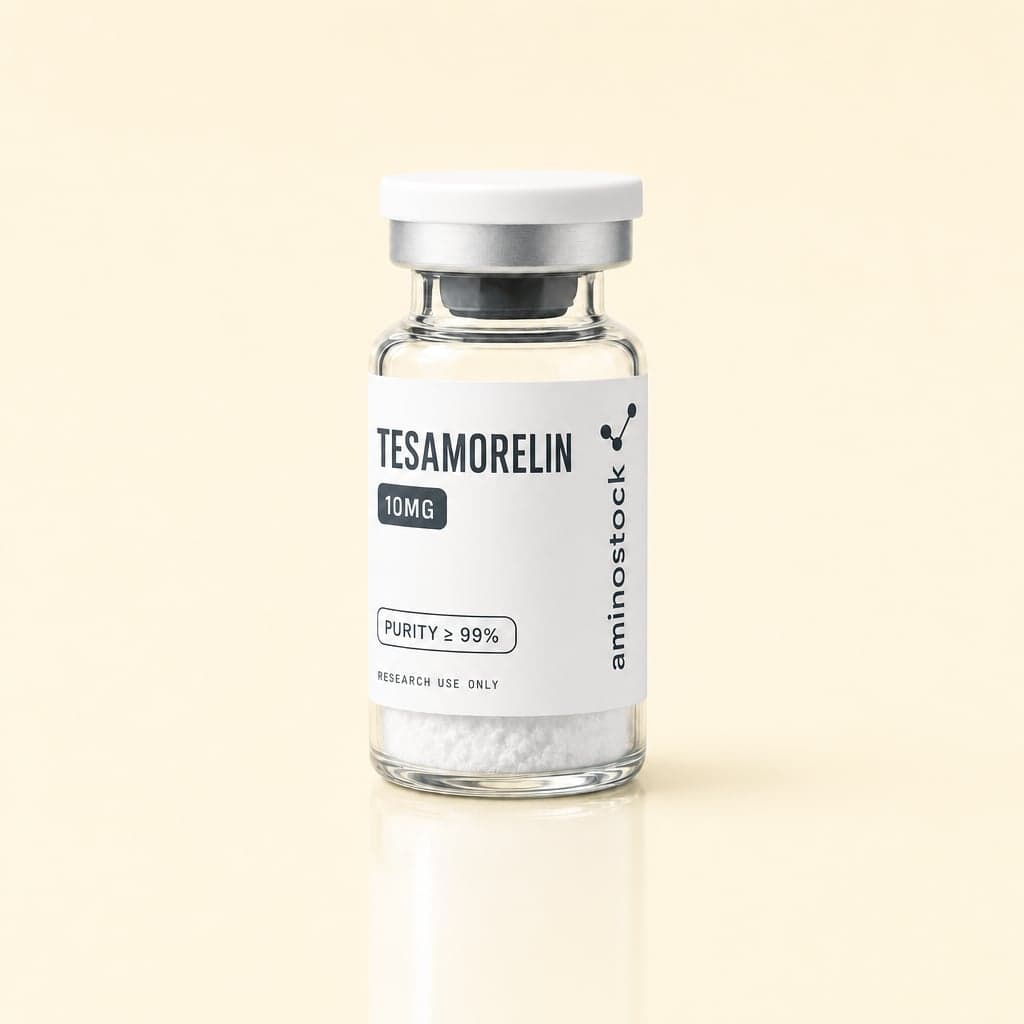
Secretagogue Peptide
Tesamorelin
A 44-amino-acid GHRH analog carrying an N-terminal trans-3-hexenoyl group, studied in preclinical pharmacology of growth-hormone secretion.
Size
Quantity
$69.99
Bundle & save
Order by 3:00 PM ET for same-day dispatch
Cutoff 3:00 PM ET · same-day dispatch
Estimated arrival in 2 business days
Overnight shipping available
Free shipment protection included
Tesamorelin
1 × 10mg · $69.99
99% purity, QC passed
HPLC + mass-spec verified
Shipment protection
Free on every order
Free shipping over $150
Same-day dispatch before 3PM ET
About Tesamorelin
Structure and research context
Tesamorelin (TH9507) is a synthetic analogue of the full-length native growth hormone-releasing factor, GRF(1-44)-NH2, a 44-residue peptide. It is minimally modified by attachment of a trans-3-hexenoyl group to the N-terminal Tyr1 residue, a change that makes the peptide resistant to inactivation by dipeptidyl aminopeptidase-IV. The molecule has the formula C221H366N72O67S and a molar mass of about 5,136 g/mol, and it is grouped with sermorelin and CJC-1295 among the synthetic analogues of growth hormone-releasing hormone (GHRH).
Tesamorelin in the research literature
Preclinical pharmacology work reported that the hexenoyl modification slowed in vitro degradation of the peptide in rat and dog plasma relative to unmodified GRF(1-44)-NH2 and prolonged its plasma elimination kinetics in vivo. Repeated exposure in pigs, rats and dogs markedly increased circulating growth hormone and insulin-like growth factor-1 (IGF-1). Subchronic toxicology studies in rats and dogs lasting up to four months characterized responses attributed to sustained supraphysiological growth hormone and IGF-1 levels, including reversible liver, kidney and hematological findings in dogs, and the apparent elimination half-life in dogs ranged from 21 to 45 minutes.
On the analytical side, nano-liquid chromatography methods coupled with quadrupole/orbitrap mass spectrometry have been validated for detecting tesamorelin alongside other GHRH analogues in urine at sub-nanogram-per-millilitre levels.
Summarized from peer-reviewed literature for research context only; not a product claim. PubMed: 17214611 · 41138283
Tesamorelin Certificate of Analysis
Third-party tested · Independent analytical lab
10mg
98.76%latest
| Tested | Measured | Purity |
|---|---|---|
| Jul 2026 | 11.12mg | 98.76% |
| Jul 2026 | 11.56mg | 99.17% |
| Jul 2026 | 11.62mg | 98.88% |
| Jun 2026 | 11.32mg | 98.08% |
| Jun 2026 | 11.65mg | 99.01% |
| May 2026 | 12.06mg | 98.72% |
| May 2026 | 11.80mg | 99.02% |
| May 2026 | 11.89mg | 99.00% |
| May 2026 | 11.72mg | 99.34% |
| Apr 2026 | 11.60mg | 99.68% |
20mg
99.36%latest
| Tested | Measured | Purity |
|---|---|---|
| Jul 2026Sterile | 23.57mg | 99.36% |
| Jun 2026 | 20.99mg | 99.19% |
| Jun 2026 | 22.01mg | 98.55% |
| May 2026 | 22.21mg | 99.01% |
| May 2026 | 22.53mg | 99.47% |
| Apr 2026 | 21.81mg | 99.51% |
| Apr 2026 | 23.30mg | 99.85% |
| Apr 2026 | 22.40mg | 99.65% |
| Feb 2026 | 23.57mg | 99.33% |
| Jan 2026 | 21.84mg | 99.71% |
Latest safety testing
- Sterility
- TAMC/TYMCJul 2026
Endotoxin, sterility, and heavy-metals reports are run on individual lots on a rotating basis, separate from the identity/purity assay above — not on every lot.
Frequently researched together
Commonly studied alongside Tesamorelin.
Compound information
Technical specifications
Molecular profile
| Type | Synthetic GHRH(1-44) analog |
| CAS number | 218949-48-5 |
| Molecular weight | 5,136 g/mol |
| Amino acids | 44 |
| Formula | C221H366N72O67S |
Storage & stability
- ❄️
Lyophilized (powder)
-20°C · stable 2+ years
- ❄️
Reconstituted
2–8°C · use within 30 days
Tesamorelin sources & references
Peer-reviewed literature, for research context
- Journal of Clinical Endocrinology & Metabolism
Effects of tesamorelin (TH9507), a growth hormone-releasing factor analog, in human immunodeficiency virus-infected patients with excess abdominal fat: a pooled analysis of two multicenter, double-blind placebo-controlled phase 3 trials with safety extension data
2010·PMID: 20554713Falutz J, et al.
View source - Lancet HIV
Effects of tesamorelin on non-alcoholic fatty liver disease in HIV: a randomised, double-blind, multicentre trial
2019·PMID: 31611038Stanley TL, et al.
View source - Archives of Neurology
Effects of growth hormone-releasing hormone on cognitive function in adults with mild cognitive impairment and healthy older adults: results of a controlled trial
2012·PMID: 22869065Baker LD, et al.
View source - Journal of Frailty & Aging
The Growth Hormone Releasing Hormone Analogue, Tesamorelin, Decreases Muscle Fat and Increases Muscle Area in Adults with HIV
2019·PMID: 31237318Adrian S, et al.
View source - JCI Insight
Effects of tesamorelin on hepatic transcriptomic signatures in HIV-associated NAFLD
2020·PMID: 32701508Fourman LT, et al.
View source
More in Metabolic
Every Metabolic research compound in the catalog.
Important research notice
Not for human consumption. This product is sold exclusively for laboratory and in vitro research. It is not intended to diagnose, treat, cure, or prevent any disease.
Any research findings referenced on this page are drawn from published, peer-reviewed literature and are provided for educational context only. They are not product claims and should not be read as medical advice.
By purchasing, you confirm you are a qualified researcher and will handle this material in accordance with all applicable laws and institutional guidelines.