For laboratory research use only — not for human or veterinary use. Not evaluated by the U.S. FDA.
Cellular Peptide
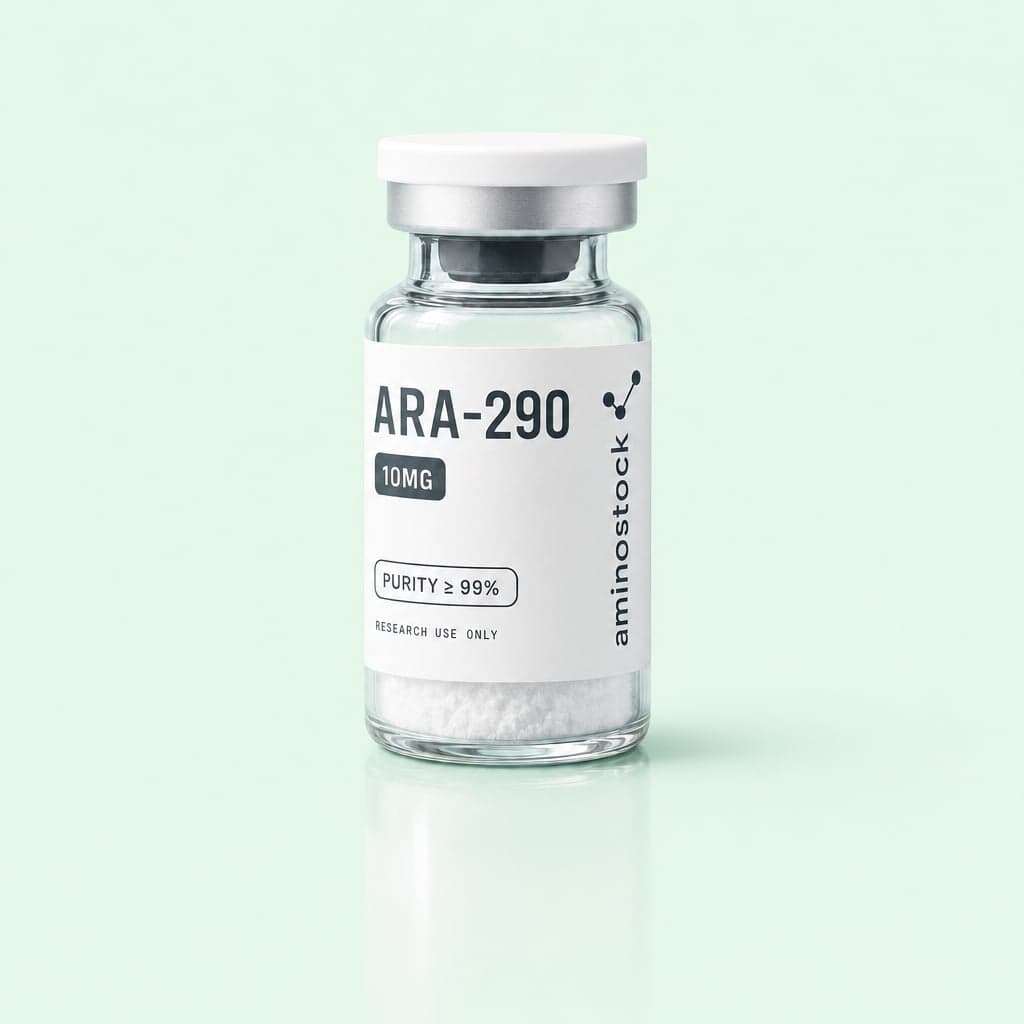
ARA-290
An 11-amino-acid peptide derived from the helix B domain of erythropoietin, studied in preclinical models for innate repair receptor signaling without the hematopoietic activity of EPO.
Size
Quantity
$49.99
Bundle & save
Order by 3:00 PM ET for same-day dispatch
Cutoff 3:00 PM ET · same-day dispatch
Estimated arrival in 2 business days
Overnight shipping available
Free shipment protection included
ARA-290
1 × 10mg · $49.99
99% purity, QC passed
HPLC + mass-spec verified
Shipment protection
Free on every order
Free shipping over $150
Same-day dispatch before 3PM ET
About ARA-290
Structure and research context
ARA-290 (cibinetide), also called pyroglutamate helix B surface peptide (pHBSP), is an 11-amino-acid peptide (C51H84N16O21, 1257.3 g/mol) modeled on the three-dimensional structure of erythropoietin (EPO) in the region of helix B. EPO signals through two receptor configurations: an EPOR homodimer that drives maturation of erythroid progenitor cells, and a heteromer of EPOR with the β-common receptor subunit (CD131) found on other cell types, including immune cells. ARA-290 was designed to engage the EPOR/CD131 heteromer selectively, without interacting with the EPOR homodimer.
ARA-290 in the research literature
Research on ARA-290 has centred on EPOR/CD131 heteromer signaling in immune and structural cells. In LPS-activated primary macrophages, the peptide's effects on inflammatory mediator production were reported to depend on CD131 and JAK2 and to involve inhibition of NF-κB p65 activity. In dextran sulphate sodium-exposed mice, it was associated with reduced myeloid-cell infiltration and lower production of cytokines, chemokines and nitric oxide synthase-2.
Other studies have looked beyond the heteromeric receptor. Calcium-imaging and cell-culture experiments reported that ARA-290 specifically inhibited TRPV1 channel activity. In bone biology, the peptide inhibited osteoclastogenesis in vitro and was associated with increased cortical and trabecular bone mineral density in mice, alongside fewer osteoclast progenitors when given with EPO.
Summarized from peer-reviewed literature for research context only; not a product claim. PubMed: 25728128 · 29026145 · 26774587 · 35008482
ARA-290 Certificate of Analysis
Third-party tested · Independent analytical lab
16mg
99.34%latest
| Tested | Measured | Purity |
|---|---|---|
| Jul 2026 | 19.75mg | 99.34% |
| May 2026 | 19.43mg | 99.70% |
| Feb 2026 | 16.28mg | 86.22% |
| Dec 2025 | 19.96mg | 99.52% |
| Dec 2025 | 20.23mg | 99.03% |
Frequently researched together
Commonly studied alongside ARA-290.
Compound information
Technical specifications
Molecular profile
| Type | 11-amino-acid erythropoietin-derived (helix B) peptide |
| CAS number | 1208243-50-8 |
| Molecular weight | 1257.3 g/mol |
| Amino acids | 11 |
| Formula | C51H84N16O21 |
Storage & stability
- ❄️
Lyophilized (powder)
-20°C · stable 2+ years
- ❄️
Reconstituted
2–8°C · use within 30 days
ARA-290 sources & references
Peer-reviewed literature, for research context
- Expert opinion on investigational drugs
ARA 290 for treatment of small fiber neuropathy in sarcoidosis
2014·DOI: 10.1517/13543784.2014.892072·PMID: 24555851van Velzen M, Heij L, Niesters M, Cerami A, Dunne A, Dahan A
View source - Journal of clinical medicine
A Phase 2 Clinical Trial on the Use of Cibinetide for the Treatment of Diabetic Macular Edema
2020·DOI: 10.3390/jcm9072225·PMID: 32674280Lois N, Gardner E, McFarland M, Armstrong D, McNally C, Lavery NJ
View source - Scientific reports
Cibinetide dampens innate immune cell functions thus ameliorating the course of experimental colitis
2017·DOI: 10.1038/s41598-017-13046-3·PMID: 29026145Nairz M, Haschka D, Dichtl S, Sonnweber T, Schroll A, Aßhoff M
View source - Biochimica et biophysica acta. Molecular basis of disease
Activation of the EPOR-β common receptor complex by cibinetide ameliorates impaired wound healing in mice with genetic diabetes
2018·DOI: 10.1016/j.bbadis.2017.12.006·PMID: 29223734Bitto A, Irrera N, Pizzino G, Pallio G, Mannino F, Vaccaro M
View source
More in Cellular
Every Cellular research compound in the catalog.
Important research notice
Not for human consumption. This product is sold exclusively for laboratory and in vitro research. It is not intended to diagnose, treat, cure, or prevent any disease.
Any research findings referenced on this page are drawn from published, peer-reviewed literature and are provided for educational context only. They are not product claims and should not be read as medical advice.
By purchasing, you confirm you are a qualified researcher and will handle this material in accordance with all applicable laws and institutional guidelines.