For laboratory research use only — not for human or veterinary use. Not evaluated by the U.S. FDA.
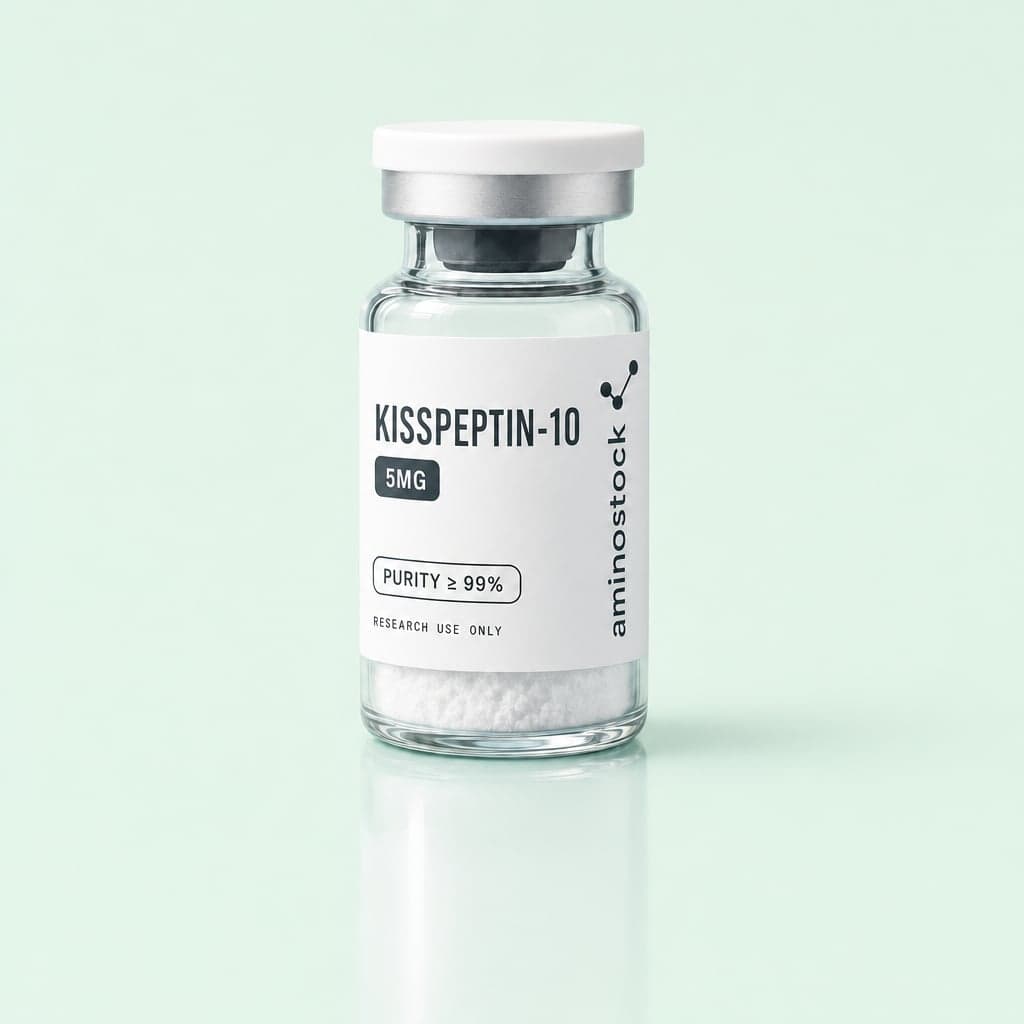
Cellular Peptide
Kisspeptin-10
A 10-amino-acid fragment of the KISS1 gene product, studied in research models as a GPR54/KISS1R agonist involved in upstream regulation of the reproductive hormone axis.
Size
Quantity
$39.99
Bundle & save
Order by 3:00 PM ET for same-day dispatch
Cutoff 3:00 PM ET · same-day dispatch
Estimated arrival in 2 business days
Overnight shipping available
Free shipment protection included
Kisspeptin-10
1 × 5mg · $39.99
99% purity, QC passed
HPLC + mass-spec verified
Shipment protection
Free on every order
Free shipping over $150
Same-day dispatch before 3PM ET
About Kisspeptin-10
Structure and research context
Kisspeptin-10 (KP-10, metastin 45-54) is a decapeptide, Tyr-Asn-Trp-Asn-Ser-Phe-Gly-Leu-Arg-Phe-NH2 (C63H83N17O14, 1302.4 g/mol), corresponding to the C-terminal decapeptide amide of kisspeptin-54, the longest product of the KISS1 gene. The kisspeptins were isolated from placental tissue in 2001 as endogenous agonists of the previously orphan G protein-coupled receptor GPR54 (KISS1R), and the 54-, 14- and 13-residue forms share a common Arg-Phe-amide (RF-amide) C-terminus. KP-10 has been described as the biologically active C-terminal fragment, sharing the activities of the full-length peptide at GPR54.
Kisspeptin-10 in the research literature
In receptor-expressing CHO cells, kisspeptins bound GPR54 with low nanomolar affinity and stimulated PIP2 hydrolysis, Ca2+ mobilization, arachidonic acid release and ERK1/2 and p38 MAP kinase phosphorylation. Much of the subsequent research has concerned hypothalamic signaling. In immortalized GT1-7 GnRH-secreting hypothalamic neurons, KP-10 produced a triphasic change in intracellular calcium that was attenuated by protein kinase C inhibition, and in perifusion studies it increased GnRH peak amplitude and duration.
Identified hypothalamic GnRH neurons were found to express GnRH, kisspeptin and GPR54 transcripts, and whole-cell patch-clamp recordings showed initial depolarization followed by increased action potential firing in response to kisspeptin. In mice, KiSS-1 mRNA was mapped to the anteroventral periventricular, periventricular and arcuate nuclei of the hypothalamus.
Summarized from peer-reviewed literature for research context only; not a product claim. PubMed: 11457843 · 16879969 · 21276835 · 17698953 · 15217982
Kisspeptin-10 Certificate of Analysis
Third-party tested · Independent analytical lab
10mg
99.85%latest
| Tested | Measured | Purity |
|---|---|---|
| Mar 2026 | 13.23mg | 99.85% |
| Jan 2026 | 12.40mg | 99.51% |
| Jan 2026 | 12.36mg | 99.50% |
| Dec 2025 | 12.56mg | 99.65% |
Frequently researched together
Commonly studied alongside Kisspeptin-10.
Compound information
Technical specifications
Molecular profile
| Type | KISS1-derived decapeptide |
| CAS number | 374675-21-5 |
| Molecular weight | 1302.4 g/mol |
| Amino acids | 10 |
| Sequence | Tyr-Asn-Trp-Asn-Ser-Phe-Gly-Leu-Arg-Phe-NH2 |
| Formula | C63H83N17O14 |
Storage & stability
- ❄️
Lyophilized (powder)
-20°C · stable 2+ years
- ❄️
Reconstituted
2–8°C · use within 30 days
Kisspeptin-10 sources & references
Peer-reviewed literature, for research context
- The Journal of clinical endocrinology and metabolism
The effects of kisspeptin-10 on reproductive hormone release show sexual dimorphism in humans
2011·DOI: 10.1210/jc.2011-1408·PMID: 21976724Jayasena CN, Nijher GM, Comninos AN, Abbara A, Januszewki A, Vaal ML
View source - Andrologia
Age-dependent changes in the reproductive axis responsiveness to kisspeptin-10 administration in healthy men
2019·DOI: 10.1111/and.13219·PMID: 30590872Ullah H, Nabi G, Zubair H, Ullah R, Shahab M
View source - Nature reviews. Endocrinology
Metabolic regulation of kisspeptin - the link between energy balance and reproduction
2020·DOI: 10.1038/s41574-020-0363-7·PMID: 32427949Navarro VM
View source
More in Cellular
Every Cellular research compound in the catalog.
Important research notice
Not for human consumption. This product is sold exclusively for laboratory and in vitro research. It is not intended to diagnose, treat, cure, or prevent any disease.
Any research findings referenced on this page are drawn from published, peer-reviewed literature and are provided for educational context only. They are not product claims and should not be read as medical advice.
By purchasing, you confirm you are a qualified researcher and will handle this material in accordance with all applicable laws and institutional guidelines.