For laboratory research use only — not for human or veterinary use. Not evaluated by the U.S. FDA.
Cellular Peptide
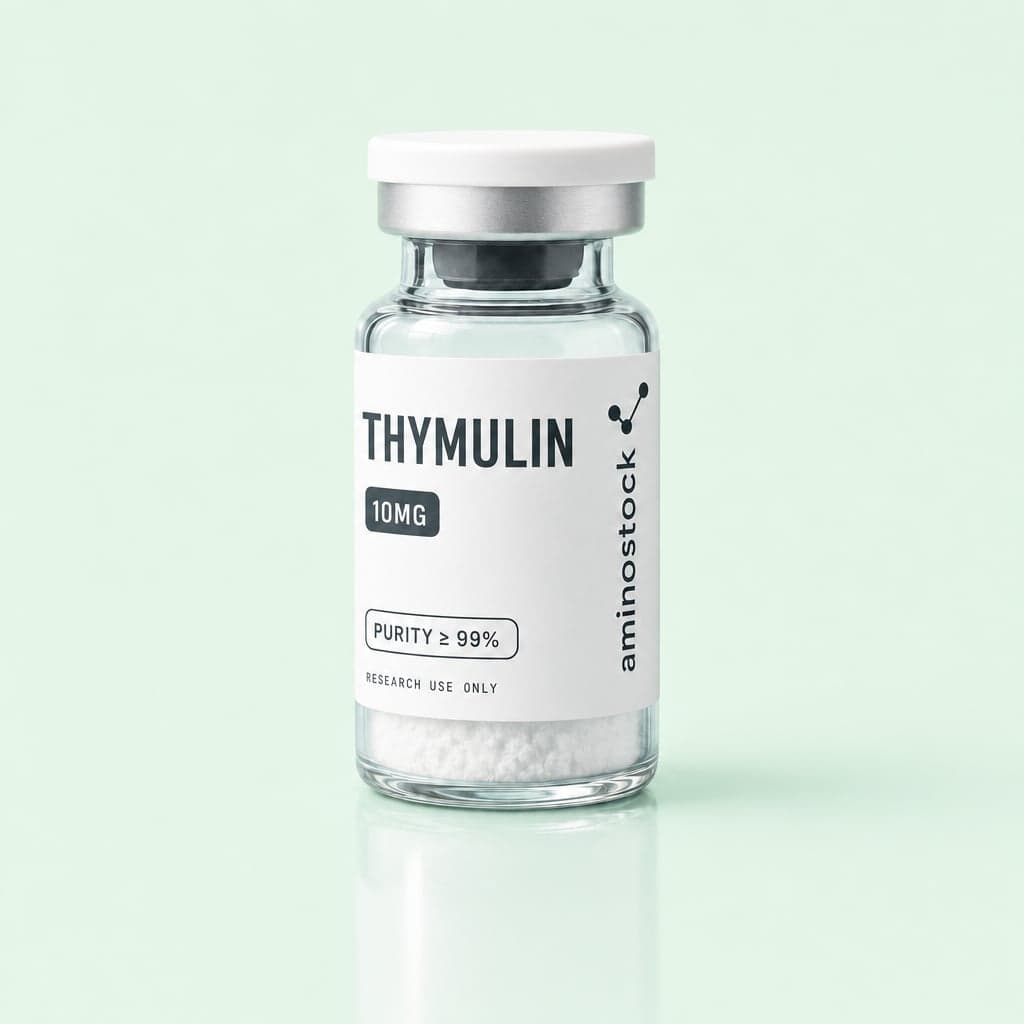
Thymulin
A zinc-dependent thymic nonapeptide hormone, studied in preclinical models for its role in T-cell differentiation and immune signaling.
Quantity
$39.99
Bundle & save
Order by 3:00 PM ET for same-day dispatch
Cutoff 3:00 PM ET · same-day dispatch
Estimated arrival in 2 business days
Overnight shipping available
Free shipment protection included
Thymulin
1 × 10mg · $39.99
99% purity, QC passed
HPLC + mass-spec verified
Shipment protection
Free on every order
Free shipping over $150
Same-day dispatch before 3PM ET
About Thymulin
Structure and research context
Thymulin, originally named facteur thymique sérique (FTS), is a nonapeptide hormone produced by thymic epithelial cells (peptide component C33H54N12O15, 858.9 g/mol). Its biological activity and antigenicity depend on zinc bound within the molecule. Monoclonal antibody studies identified epitopes recognized only on the zinc-coupled form, indicating a zinc-specific conformation, consistent with NMR data showing a distinct structure for the zinc-containing hormone. Thymulin was discovered in the early 1970s and characterized as a thymic hormone involved in aspects of intrathymic and extrathymic T-cell differentiation.
Thymulin in the research literature
Early work characterized thymulin as a factor that induces T-cell differentiation and modulates functions of several T-cell subsets, with its effects on suppressor T cells considered the most pronounced. Studies with thymic explants from old mice reported that thymulin output in short-term culture was similar to that of young thymuses but that the zinc-bound form was nearly absent, and that adding zinc to the cultures restored it.
Later research has examined links between thymulin and the neuroendocrine system, including evidence that its secretion is influenced by neuroendocrine signals and that it acts as a hypophysotropic peptide. In fetal alveolar type II epithelial cell culture, thymulin reduced endotoxin-induced IL-1β release, increased cAMP, and reduced nuclear translocation of the NF-κB subunit RelA (p65).
Summarized from peer-reviewed literature for research context only; not a product claim. PubMed: 2413455 · 2657247 · 8582786 · 19236333 · 19850345
Frequently researched together
Commonly studied alongside Thymulin.
Compound information
Technical specifications
Molecular profile
| Type | Zinc-dependent thymic nonapeptide hormone |
| CAS number | 63958-90-7 |
| Molecular weight | 858.9 g/mol |
| Amino acids | 9 |
| Formula | C33H54N12O15 |
Storage & stability
- ❄️
Lyophilized (powder)
-20°C · stable 2+ years
- ❄️
Reconstituted
2–8°C · use within 30 days
Thymulin sources & references
Peer-reviewed literature, for research context
- Medical oncology and tumor pharmacotherapy
Thymulin, a zinc-dependent hormone
1989·DOI: 10.1007/BF02985220·PMID: 2657247Bach JF, Dardenne M
View source - The Journal of clinical investigation
Serum thymulin in human zinc deficiency
1988·DOI: 10.1172/JCI113717·PMID: 3262625Prasad AS, Meftah S, Abdallah J, Kaplan J, Brewer GJ, Bach JF
View source - Proceedings of the National Academy of Sciences of the United States of America
A zinc-dependent epitope on the molecule of thymulin, a thymic hormone
1985·DOI: 10.1073/pnas.82.20.7035·PMID: 2413455Dardenne M, Savino W, Berrih S, Bach JF
View source - International journal of immunopharmacology
Age-related thymus involution: zinc reverses in vitro the thymulin secretion defect
1995·DOI: 10.1016/0192-0561(95)00064-9·PMID: 8582786Mocchegiani E, Fabris N
View source
More in Cellular
Every Cellular research compound in the catalog.
Important research notice
Not for human consumption. This product is sold exclusively for laboratory and in vitro research. It is not intended to diagnose, treat, cure, or prevent any disease.
Any research findings referenced on this page are drawn from published, peer-reviewed literature and are provided for educational context only. They are not product claims and should not be read as medical advice.
By purchasing, you confirm you are a qualified researcher and will handle this material in accordance with all applicable laws and institutional guidelines.