For laboratory research use only — not for human or veterinary use. Not evaluated by the U.S. FDA.
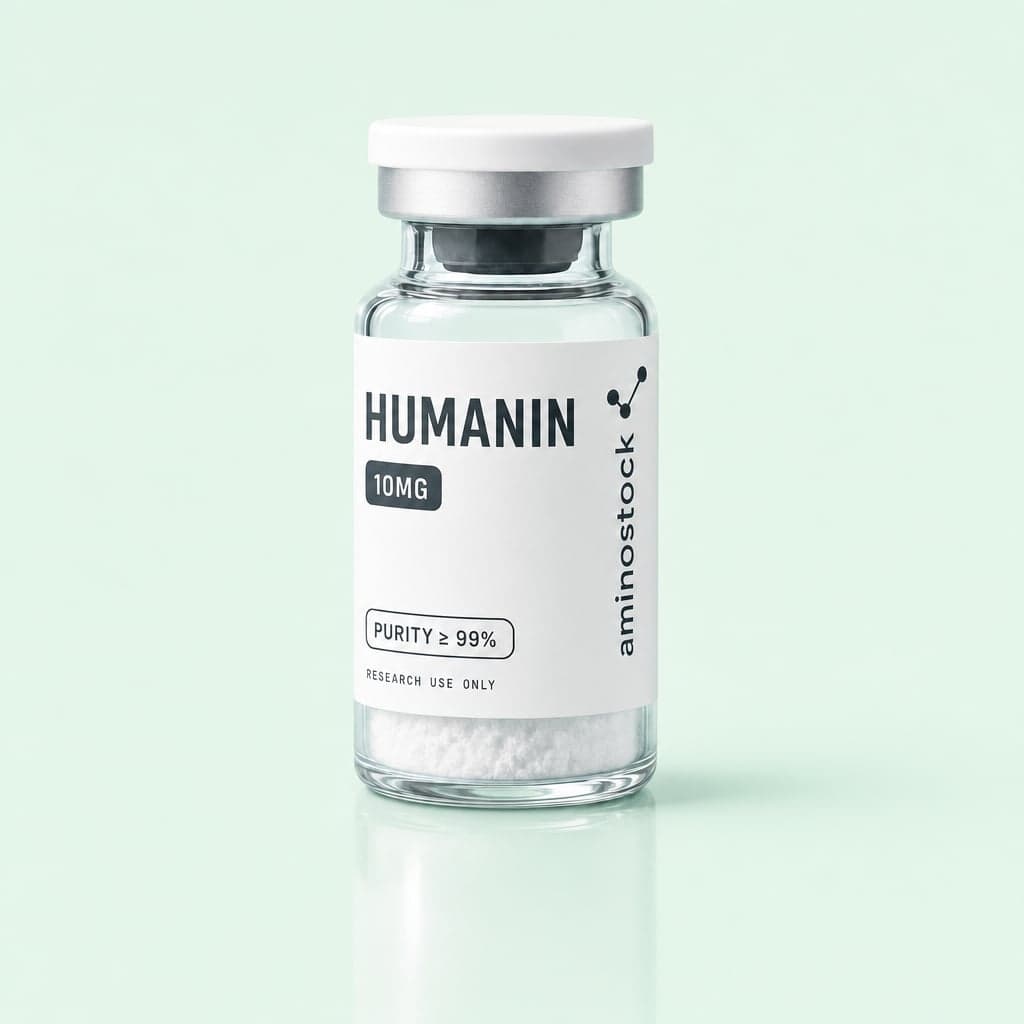
Cellular Peptide
Humanin
A 24-amino-acid mitochondrial-derived peptide, studied in preclinical models for cytoprotective and metabolic signaling pathways.
Quantity
$138.99
Bundle & save
Order by 3:00 PM ET for same-day dispatch
Cutoff 3:00 PM ET · same-day dispatch
Estimated arrival in 2 business days
Overnight shipping available
Free shipment protection included
Humanin
1 × 10mg · $138.99
99% purity, QC passed
HPLC + mass-spec verified
Shipment protection
Free on every order
Free shipping over $150
Same-day dispatch before 3PM ET
About Humanin
Structure and research context
Humanin is a 24-amino-acid peptide (MAPRGFSCLLLLTSEIDLPVKRRA; C119H204N34O32S2, 2,687.2 g/mol) classed as a mitochondrial-derived peptide because it is encoded within mitochondrial DNA. It was identified in 2001 through a functional expression screen for cDNAs that suppress neuronal cell death in culture; the transfected cDNA was transcribed into the corresponding polypeptide, which was secreted into the culture medium, and its activity depended on its primary structure. Humanin has since been detected in several tissues with high metabolic rates, including glial cells of the brain.
Humanin in the research literature
Two receptor systems have been described for humanin. In cell-based binding and loss-of-function studies, the peptide induced hetero-oligomerization of ciliary neurotrophic factor receptor alpha (CNTFR), the IL-27 receptor subunit WSX-1 and gp130, with STAT3 activation implicated downstream. Separately, humanin suppressed forskolin-induced cAMP production in CHO cells expressing formyl peptide receptor-like 1 (FPRL1) or FPRL2, and an N-formylated form was markedly more potent at FPRL1. Reviews also describe JAK/STAT signaling and interactions with BCL-2 family proteins.
In rat hippocampus, humanin immunoreactivity colocalized with astroglial markers, and cultured astrocytes were shown to produce and release the peptide. In primary cultures of hippocampal neurons, humanin reduced glutamate-induced dendritic atrophy and the loss of synaptophysin-positive puncta.
Summarized from peer-reviewed literature for research context only; not a product claim. PubMed: 11371646 · 33130077 · 19386761 · 15465011 · 31214013
Humanin Certificate of Analysis
Third-party tested · Independent analytical lab
10mg
97.59%latest
| Tested | Measured | Purity |
|---|---|---|
| May 2026 | 11.18mg | 97.59% |
| Jan 2026 | 9.77mg | 99.05% |
Frequently researched together
Commonly studied alongside Humanin.
Compound information
Technical specifications
Molecular profile
| Type | Mitochondrial-derived peptide |
| CAS number | 330936-69-1 |
| Molecular weight | 2,687.2 g/mol |
| Amino acids | 24 |
| Sequence | MAPRGFSCLLLLTSEIDLPVKRRA |
| Formula | C119H204N34O32S2 |
Storage & stability
- ❄️
Lyophilized (powder)
-20°C · stable 2+ years
- ❄️
Reconstituted
2–8°C · use within 30 days
Humanin sources & references
Peer-reviewed literature, for research context
- Life sciences
Humanin: A mitochondrial-derived peptide in the treatment of apoptosis-related diseases
2021·DOI: 10.1016/j.lfs.2020.118679·PMID: 33130077Hazafa A, Batool A, Ahmad S, Amjad M, Chaudhry SN, Asad J
View source - Archives of cardiovascular diseases
Role of humanin, a mitochondrial-derived peptide, in cardiovascular disorders
2020·DOI: 10.1016/j.acvd.2020.03.020·PMID: 32680738Rochette L, Meloux A, Zeller M, Cottin Y, Vergely C
View source - Journal of molecular endocrinology
The emerging role of the mitochondrial-derived peptide humanin in stress resistance
2013·DOI: 10.1530/JME-12-0203·PMID: 23239898Yen K, Lee C, Mehta H, Cohen P
View source - Frontiers in aging neuroscience
Humanin, a Mitochondrial-Derived Peptide Released by Astrocytes, Prevents Synapse Loss in Hippocampal Neurons
2019·DOI: 10.3389/fnagi.2019.00123·PMID: 31214013Zárate SC, Traetta ME, Codagnone MG, Seilicovich A, Reinés AG
View source
More in Cellular
Every Cellular research compound in the catalog.
Important research notice
Not for human consumption. This product is sold exclusively for laboratory and in vitro research. It is not intended to diagnose, treat, cure, or prevent any disease.
Any research findings referenced on this page are drawn from published, peer-reviewed literature and are provided for educational context only. They are not product claims and should not be read as medical advice.
By purchasing, you confirm you are a qualified researcher and will handle this material in accordance with all applicable laws and institutional guidelines.