For laboratory research use only — not for human or veterinary use. Not evaluated by the U.S. FDA.
Cellular Peptide
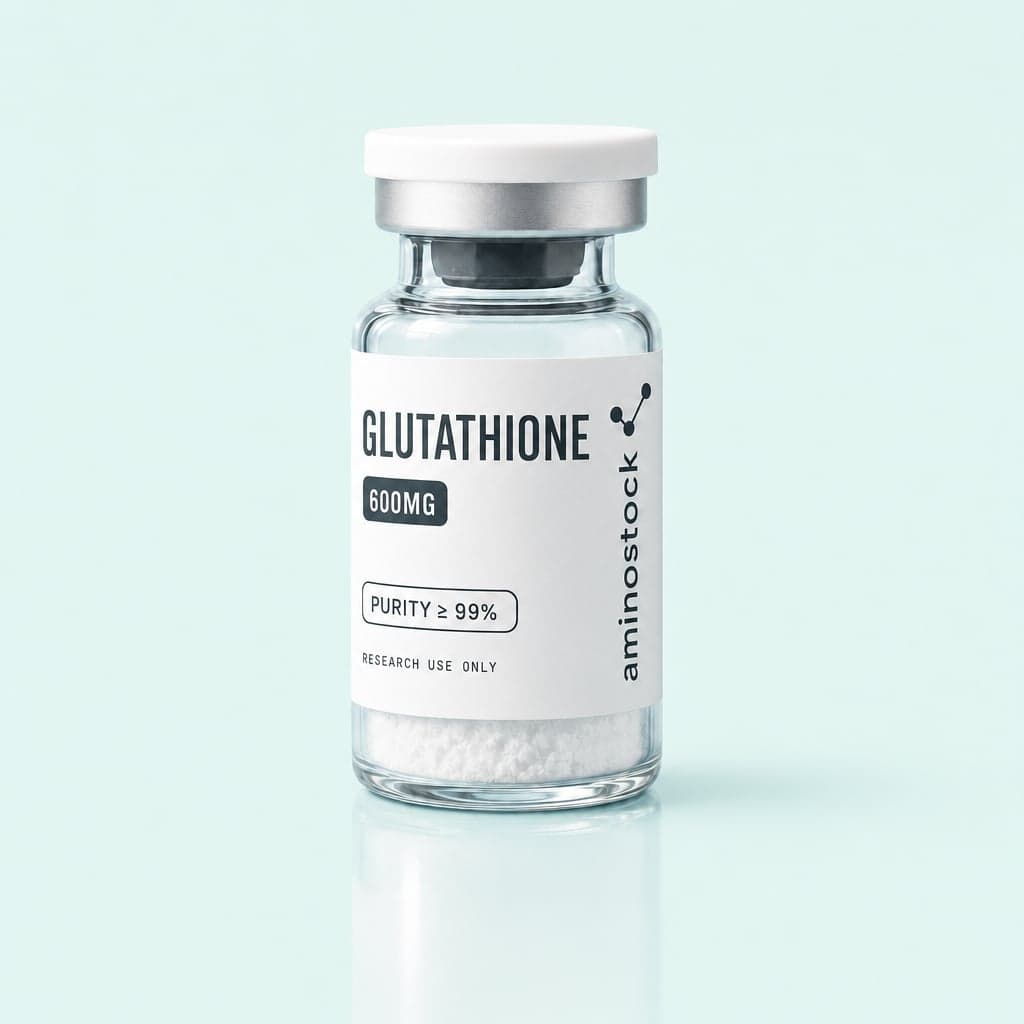
Glutathione
A cysteine-containing tripeptide that acts as a principal cellular antioxidant, studied for redox balance and detoxification pathways in research models.
Size
Quantity
$44.99
Bundle & save
Order by 3:00 PM ET for same-day dispatch
Cutoff 3:00 PM ET · same-day dispatch
Estimated arrival in 2 business days
Overnight shipping available
Free shipment protection included
Glutathione
1 × 600mg · $44.99
99% purity, QC passed
HPLC + mass-spec verified
Shipment protection
Free on every order
Free shipping over $150
Same-day dispatch before 3PM ET
About Glutathione
Structure and research context
Glutathione (GSH) is a tripeptide, γ-L-glutamyl-L-cysteinyl-glycine (C10H17N3O6S, 307.32 g/mol), in which glutamate is joined to cysteine through a γ-glutamyl linkage and the cysteine supplies a free thiol group. It is the most abundant low-molecular-mass thiol in animal cells, and the reduced glutathione/glutathione disulfide (GSH/GSSG) pair is the major cellular redox couple. GSH is synthesized from glutamate, cysteine and glycine by two sequential cytosolic enzymes, γ-glutamylcysteine synthetase and GSH synthetase.
Glutathione in the research literature
Biochemical work on glutathione has examined how its synthesis is controlled, and reviews identify γ-glutamylcysteine synthetase activity, cysteine availability and feedback inhibition by GSH as the principal regulatory points. Nutritional studies in animal models link protein supply to the maintenance of tissue GSH homeostasis. Glutathione has been studied for roles in antioxidant defense, nutrient metabolism, gene expression, signal transduction, cytokine production and protein glutathionylation.
Related enzymology has focused on the glutathione peroxidase (GPx) family, which reduces hydroperoxides. The cytosolic enzyme GPx1 was established as the first selenoenzyme described in vertebrates, and mechanistic studies using density functional theory and NMR of model compounds describe a selenolate being oxidized to a selenenic acid during the catalytic reaction.
Summarized from peer-reviewed literature for research context only; not a product claim. PubMed: 14988435 · 35580774
Glutathione Certificate of Analysis
Third-party tested · Independent analytical lab
600mg
99.07%latest
| Tested | Measured | Purity |
|---|---|---|
| Dec 2025 | 680.56mg | 99.07% |
1500mg
99.59%latest
| Tested | Measured | Purity |
|---|---|---|
| Nov 2025 | 1655.04mg | 99.59% |
Frequently researched together
Commonly studied alongside Glutathione.
Compound information
Technical specifications
Molecular profile
| Type | Tripeptide (γ-Glu-Cys-Gly) |
| CAS number | 70-18-8 |
| Molecular weight | 307.32 g/mol |
| Sequence | γ-L-Glutamyl-L-cysteinyl-glycine |
| Formula | C10H17N3O6S |
Storage & stability
- ❄️
Lyophilized (powder)
-20°C · stable 2+ years
- ❄️
Reconstituted
2–8°C · use within 30 days
Glutathione sources & references
Peer-reviewed literature, for research context
- European Journal of Nutrition
Randomized controlled trial of oral glutathione supplementation on body stores of glutathione
2015·DOI: 10.1007/s00394-014-0706-z·PMID: 24791752Richie JP Jr, Nichenametla S, Neidig W, et al.
View source - Journal of Dermatological Treatment
Glutathione as an oral whitening agent: a randomized, double-blind, placebo-controlled study
2012·DOI: 10.3109/09546631003801619·PMID: 20524875Arjinpathana N, Asawanonda P
View source - Applied Physiology, Nutrition, and Metabolism
The effects of 3 weeks of oral glutathione supplementation on whole body insulin sensitivity in obese males with and without type 2 diabetes
2021·DOI: 10.1139/apnm-2020-1099·PMID: 33740389Søndergård SD, Cintin I, Kuhlman AB, et al.
View source - BMC Gastroenterology
Efficacy of glutathione for the treatment of nonalcoholic fatty liver disease: an open-label, single-arm, multicenter, pilot study
2017·DOI: 10.1186/s12876-017-0652-3·PMID: 28789631Honda Y, Kessoku T, Sumida Y, et al.
View source - Journal of Nutrition
Glutathione metabolism and its implications for health
2004·PMID: 14988435Wu G, Fang YZ, Yang S, et al.
View source - European Journal of Clinical Nutrition
Oral supplementation with liposomal glutathione elevates body stores of glutathione and markers of immune function
2018·PMID: 28853742Sinha R, Sinha I, Calcagnotto A, et al.
View source
More in Cellular
Every Cellular research compound in the catalog.
Important research notice
Not for human consumption. This product is sold exclusively for laboratory and in vitro research. It is not intended to diagnose, treat, cure, or prevent any disease.
Any research findings referenced on this page are drawn from published, peer-reviewed literature and are provided for educational context only. They are not product claims and should not be read as medical advice.
By purchasing, you confirm you are a qualified researcher and will handle this material in accordance with all applicable laws and institutional guidelines.